Thursday, October 3, 2013

Remember the Alamo

Day three of the government shutdown, and things were looking bleak. Hoping for some respite from being unemployed, I ventured back into society this afternoon and joined my mother in one of our favorite pastimes- going to the movies.  Today we visited the Thirteenth Wonder of the World: the Alamo Drafthouse Cinema.

Founded in 1977 by Tim and Karrie League in Austin, Texas, the Alamo Cinema Drafthouse chain of theaters is famous not only for its hard-line stance on theatre etiquette, but also their amazing food and beer selections-- that can be ordered and served to your seats in the theatre!  Fortunately for me, I've had the pleasure of visiting three of the Alamo locations: the Alamo Drafthouse at the Ritz in Austin, Texas, the Alamo Drafthouse Winchester in (surprise!) Winchester, Virginia, and the brand-new Alamo Drafthouse One Loudoun in Ashburn, Virginia.


The new One Loudoun location is a beer aficionado's dream come true. Incorporated into the theatre is the Glass Half Full bar, which sports 32 draft beers on tap. Before our flick this afternoon, my mother bellied up to the bar ordered us each a Pumple Drumpkin Spiced Ale by Cisco Brewers in Nantucket, Massachusetts. Not to step on Brian's Octoberquest toes, but I did not care for this beer. It tasted rather chemically and nothing like pumpkin. In general, I don't really favor pumpkin beers.

The friendly bartender, hearing this and maybe hoping to pad his tab, suggested a bottle of Frog's Hollow Double Pumpkin Ale for the low, low price of $25. Now, maybe it was being off for three days in a row, or just because she's awesome, but when the lights went down in the theatre Mother ordered that $25 bottle of ale. And it was DELICIOUS. It tasted just like someone had liquified the best pumpkin pie you've ever had and put it in a bottle. Pumpkin-y, with just the right amount of spice-- this is a darn good beer.

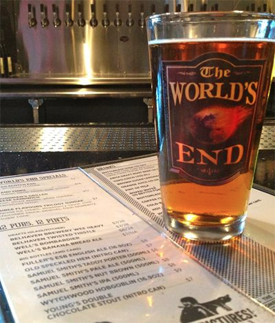
Appropriately, the flick we saw this afternoon was The World's End, the finale to the famed "Three Flavors Cornetto Trilogy" by Edgar Wright, Simon Pegg and Nick Frost. The basic premise (spoilers ahead?) of The World's End is that a group of high school friends get together to re-do the epic pub crawl they didn't finish 20 years earlier. Called the "Golden Mile" in their hometown of Newton Haven, Great Britain, it consists of 12 pubs and ends at the pub aptly called "The World's End." I won't get into the nitty-gritty of it all, but the lads eventually find out that their town has been taken over by aliens looking to make Earth "perfect" so it can peacefully enter a intergalactic federation of planets or some such. In the end, the boys save the world, usher out the aliens, but end up plunging the world back into the technological (and literal) Dark Ages. Pretty deep for a film about a night out boozing, but I really enjoyed it. Edgar Wright has described the film as "social science fiction," and I think that is an excellent description. The performances were excellent, as can be expected from this group, and my mother and her boyfriend both professed to liking it, despite thinking it was going to be a buddy pic à la The Hangover and not a sci-fi film.

So there you have it- a location, beer, and film review all in one. If you're on furlough too, or just need a nice excursion out, do yourself a favor and find an Alamo and get there post haste. I promise you won't regret it.

Tuesday, October 1, 2013

American Pale Ale: A Homebrewer's Journey

     When you order a porter or a stout, what do you expect? If you're like me, you expect a dark, roasty, malt-forward beverage that reminds you of coffee, chocolate or even black licorice. When you order an IPA, what do you expect? You probable expect a piney, citrusy, spicy, hop-forward golden-to-amber beverage that smacks your tongue with bitterness but balances itself with a hint of malty sweetness. When you order an American Pale Ale, what do you expect? This is a question I have had difficulty answering. In fact, I find the Beer Judge Certification Program Style Guidelines (the guidelines by which beers are usually judged at homebrew competitions) to be rather vague in describing this particular style. They claim there should be moderate to accentuated hop flavor, some maltiness and a light color. To me, this leaves the style open to a wide variety of interpretations.
     Usually when I order beer from a craft brewery I've never tried, I like to try their pale ale first. I feel like for a craft brewery, the pale ale is a good “base model” (unless the brewery is heavily reliant on some sort of blonde lager). It is sort of a mission statement for the brewery. For example, if a brewery's Pale Ale is extremely hoppy, in my experience, their beers are most likely intense across-the-board. Their IPAs will most likely be damn-near imperial and their stouts will probably be tasty barley stew. On the other hand, some breweries make pale ales that just...are. They lack hoppiness and offer little exceptional flavor, while still tasting like decent craft beers. I don't blame these breweries for making these types of pale ales because I realize they are not making them for me. As the base model, they are offering something that invites those not accustomed to strong flavors into the realm of craft beer.
     So, an American pale ale is a light-in-color beer that falls somewhere between a cream ale (a blonde ale that has little to no hop flavor) and an American IPA. Given such a large target, I had to first establish what I thought an American Pale Ale should be.
     My first attempt to to brew an American pale ale was literally the pale ale recipe from John Palmer's hombrewer's bible, How to Brew. The beer I produced was delicious, but it wasn't quite where I wanted it to be. It was moderate, in every way. The best evidence of this were the responses I received from non-craft-beer-drinking friends and family. Being a homebrewer, I have come to read between the lines with comments like “this is pretty good, even though I'm not really a beer drinker,” or “this is really smooth.” I wanted a beer that was drinkable, but still challenging. I wanted “whoa! That's interesting.” I wanted faces to pucker. I wanted my base model to come with alloy wheels and an upgraded stereo. What I got was a basic CD player and hub caps.
     My second attempt, in retrospect, was a step further towards the mundane. I added a touch more hops but this did nothing to balance the additional specialty grain I added. What I ended up with was even less challenging and something even more “smooth.” I entered this beer into a homebrew competition and the comments I received reflected a lackluster palate pleaser. The beer was described as a decent ale, with enough bitterness, but lacking in actual hop flavor. It was disappointing that I hadn't placed in the competition but exciting to get feedback that confirmed my suspicions. I knew from the first taste, I hadn't reached my ultimate goal.
     At this step, I decided to do some pale ale soul searching. I knew I loved Sierra Nevada's interpretation of the style, but why did I love it? I put a Sierra Nevada up against my competition pale ale and let me tongue decipher the mystery. My beer was malty and smooth but it didn't have the citrusy punch of American hops that dominated the Sierra Nevada. It wasn't bitterness I was missing, it was a refreshing orange-grapefruit zap that livens up one's drinking experience.
     My soul search also led me to several other craft pale ales. Of the most notable, Troëgs' pale ale and Oskar Blues Dale's Pale Ale seemed to have that same citrusy punch I was looking for; however, both of these beers seemed to be pushing the boundaries of the American pale ale style. At 45 IBU (International Bittering Units), Troëgs is at the very limit of the style, as established by the BJCP style guidelines. At 65 IBUs, Oskar Blues has, in my opinion, stepped over the line into an IPA. I liked where I was with the bitterness of my own pale ale (44 IBUs). It was pushing the limits of pale ale bitterness like the Troëgs pale ale, but it still needed more hop flavor.
     How does one add hop flavor without adding bitterness? The bitterness of hops is determined by their Alpha Acid content while hop flavor is determined by the unique flavors inherent in each individual hop type. Brewers add hops to boiling wort (malt-sugar-laden water) to add bitterness and hop flavor to the final beer. Traditionally, brewers utilize an hour long boil for their hop additions. The longer hops are boiled, the more bitterness is extracted from the alpha acids. Less time in the boil imparts less bitterness from the hops but means there will be more of the hop flavor in the final beer.
     I realized if I wanted that same orange-grapefruit zap I loved so much in the Sierra Nevada and other craft pale ales, I needed hop additions of a citrusy American hop type later in my boil (this was also one of the suggestions I received from the homebrew competition judges). I had, by habit, long been adding flavor and aroma hop additions at thirty and forty-five minutes into the boil. I decided to make my additions of Cascade (a citrusy American hop variety) instead at forty and fifty five minutes. Using later additions left more hop flavor in the final beer and meant that I could add a larger load of hops than I had originally, without overstepping the bitterness. Additionally, I dropped a whole pound of malt from the original recipe to assist in bringing the Cascade to the forefront.
     As I write this, I am drinking the light-in-color, hop zinging, balanced, fruit of my labor I found at the end of my long journey for my own American pale ale. I feel my quest has ended in a base model beer that excites and challenges but doesn't overstep it's label. I only fear now that my five gallon batch will be way too small to satisfy my desire for this delicious brew. 

Sunday, September 29, 2013

OctoberQuest - A Review


The end of September is upon us, and that means that October is just around the corner. What's the significance, you ask? October means it's time for me to embark on my second annual OctoberQuest.

Last year, I set out to take advantage of the Fall seasonal beer craze. For each of the 31 days in October, I drank a different seasonal beer and briefly reviewed it. It was such a lovely experience that I've decided to continue it into this year. That being said, it's always good to remember where you've come from before you think about where you're going. Without further ado, here are last year's reviews:


Takeaways from last year:

  • Interesting breakdown for scores of 4 or higher - 5 Octoberfest/Marzens and only 1 Pumpkin Ale
  • I took issue with a number of entries' sour bite/finish
  • Several were sweeter than I care for, but that may just be my preference as opposed to poor execution


So, for this year's OctoberQuest II, I'll be posting weekly recaps for a whole new 31 Fall seasonals. Hopefully I'll be raving about a few more Pumpkin Ales than last year!

Saturday, September 28, 2013

Drink Your Prayers

It's like drinking prayer. Righteous!


The reward for my persistence!
This reminds me of when I was in Geneva, Switzerland. We found this awesome pub down the street from our hostel. The first night we went there, I was trying to order a Chimay, but, at the time, I did not quite know how to pronounce it. I calmly tried to order it twice as the bartender stared at me like I had 2 noses. Then, I quickly rattled through all of the possible pronunciations I could come up with. I finally hit the right one and the bartender exclaimed, "AH! Chimay! Chimay bleu!"


With such godly beers in Europe, it's no wonder I found Christ in Germany!


Friday, September 27, 2013

Dogfish Head Punkin Ale

Well, I tried it again this year. I just really want to like the Dogfish Head Punkin Ale, but I can't seem to get into it. I try it year after year. I seem to forget somewhere in between November and September that I don't actually enjoy this beer.

Perhaps I keep coming back to it because I love pumpkin beers, when they are done correctly. I particularly love Sam Adam's Harvest Pumpkin! Perhaps I keep coming back to it because I trust Dogfish Head. I can't lay down enough praise for many of their brews (Chicory Stout, 60min IPA, 90min IPA, 75min IPA, etc.) and I can't say anything negative about my experience at their Dogfish Head Alehouse in Gaithersburg, MD. There is also the fact that, if one watches "Brew Masters", which I highly recommend, one learns that Sam Calagione, the founder and CEO of Dogfish Head, won his first beer award for his original, home brewed, Punkin' Ale.  Of course, this is all a matter of opinion, and, if Beeradvocate is any indication, Dogfish Head is "doin' it right," but this beer just doesn't work for me.

I will get into the review, now!

I like to start with the packaging, and I find the packaging for this beer to be very pleasing. The deep orange of the holder is very eye catching, the bottle holds the raised Dogfish Head symbol which I have grown to love and the label is informative and enticing. This is not to say that there is anything particularly special about the packaging, but it is welcoming in it's simplicity while still evoking the feeling that this is a special beer to be enjoyed this season. (I would post a picture of the packaging, but I only bought a single bottle this year, and I am not in the mood to steal someone else's picture right now...deal with it!)

The pour is the first indication of a let-down for me. The beer just doesn't have much head. You can splash this one right into a glass sitting upright on the table and probably not worry about losing a drop. Maybe that is what Sam and his crew go for with this beer, but I don't like it. For one, this is a pumpkin and pumpkin pie spice beer. There is definitely a scent of pumpkin pie to this one. These scents make me think of a nice, big piece of pumpkin pie with a generous dollop of whipped cream on top. For me, I associate this whipped cream on the pumpkin pie with the head on a pumpkin pie-ish beer. I want a nice foamy head with at least some moderate retention. Instead, with this beer, I get a bit of soapy foam that dissipates to a tiny bit of soapy foam rather quickly. The color, however, is a beautiful coppery orange. They are spot on with the color!


The nose on this one is very spicy. It smells like fall and Christmas spices. I know I am talking about two different "seasons" here, but, let's be honest; the same spices go in pumpkin pie as go in eggnog, and, plenty of you eat pumpkin pie at Christmas, too! (Note to self: post about homemade eggnog this year!) I don't really pick up much pumpkin, though. I mainly get spices out of this one.

The taste, aka the reason we all came to this party: this one starts off with all of the spices and a bit of sweetness and then finishes, pretty harshly, with mostly the spice and only a hint of residual sweetness. I would like a lot more sweetness and less harsh, dry, spicy action in a beer that brings thoughts of pumpkin pie into my head. I am also still searching for pumpkin at this point.

The mouth feel on this one is rather uninteresting. It is not water, but it is pretty close. I also think this shows a lack of the pumpkin I am searching for in this beer. I find that pumpkin, when introduced into the brewing process in a certain way, adds a very interesting character to the body of a beer which I just don't pick up with the Dogfish Head Punkin.

Overall, this beer is just lacking for me. When I go into a pumpkin ale, I expect more head with a nice retention, more sweetness on the finish and more....well...pumpkin. Now, I know there a lot of pumpkin spice beers out there that simply use the spices reminiscent of pumpkin pie to give the beer a fall personality, but Dogfish Head makes a pretty big deal out of the fact that they actually put pumpkin in this beer. This leaves me a bit bewildered as to where the pumpkin went in the brewing process. I love you, Dogfish Head, but I just can't get behind your Punkin' Ale. I feel like a traitor for writing this as my first review, but, half the decorations/stickers/coasters on my homemade kegerator and half the bottles inside the thing have your logo on them! I promise that positive Dogfish Reviews will be coming! Don't hate me, Sam!!!!!

I am sure I will have to review this again next year, since I just can't seem to give up on this beer. Let's see if my tastebuds change, since I am pretty sure the recipe won't! After all, they certainly don't seem to need my dollars for this brew to be a success (even though they continue to get them despite my supposed dislike of the beer!)

Now, for a shameless plug! My absolute favorite pumpkin beer happens to be the one that I brew every year! I can't claim the recipe, since I found it here, but I still claim the batches I personally produce! I made an extra batch this year since it is so popular with friends and family, and it should all be in bottles (I might keg half of it) and ready to drink just in time for Halloween! Look forward to a post detailing this year's pumpkin brew!


Sunday, September 15, 2013

Off Limits

City Hall subway stop - now an eerie ghost town.
I'm fairly fascinated with abandoned spaces that were once great sanctuaries of days gone by. For example, when I found out a few years ago that one could catch a glimpse of New York City's old decommissioned City Hall subway stop, I jumped at the opportunity. Turns out it's just as easy as riding the 6 train to it's final southbound stop (Brooklyn Bridge), and instead of getting off the train, staying right in your seat. While the train turns around to begin its journey northbound, you get to see all of the City Hall stop in its former glory, albeit in fairly low light.

So when I recently stumbled upon
a television program on the Travel Channel called "Off Limits," I was immediately intrigued. Just as you'd expect, the show's host, Don Wildman, visits abandoned sites, unexplored areas, and places where the unwashed masses are simply not granted access. With my growing knowledge of Prohibition, I immediately went to "Off Limits"'s website to check if Don had taken any trips to speakeasies. While I guessed wrong on Rum Patrol-applicable subject matter, a trio of "Off Limits" clips were definitely fun watches.

First up, Don finds himself in St. Paul, MN, to visit Schmidt's Brewery, which has been closed since 2002, ending its 147 years of on-site brewing. In the last 10 years, the property has been the subject of development plans ranging from an entire urban village complete with apartments, condos, and retail space, to smaller-scale live/work artist spaces. Unfortunately, nothing has materialized and the entire 15-acre site lies dormant and for sale once again.


Just as Don mentions the Schmidts' deviation from using underground tunnels, the next clip finds our intrepid host there - the underground beer tunnels of Lemp Brewing Company in St. Louis, MO. As Don mentions, the brewery was bought out by International Shoe Company in 1922. Since then, the 14 acre site has become home to various warehouses, office, and light industrial space. Interestingly enough, though the tunnel system remains largely abandoned, several buildings' basements get rented from time to time for uses such as Halloween haunted houses and rave parties.


Taking a huge left turn from the above two clips, we finish off with a back-of-the-house look at Aria Resort and Casino's alcohol distribution system in Las Vegas, NV. This is simply something you must see to believe. The intricacy of the system is certainly an awesome sight, but I can't help but wonder if it takes a bit of the mystique of drink preparation out of the equation. I feel like this is the way the Jetsons would receive their drinks...


With "Off Limits" having just kicked off its third season, I would certainly recommend setting your DVR to record this show whenever it pops up. There's certainly no shortage of fascinating places Don's visited and figures to visit moving forward.

That being said, watching these clips almost feels like a call to action for me. Are there any other libationary "off limits" sites that Rum Patrol can track down and, with a little luck, actually visit? With a little detective work and persistence, hopefully we will in the future.

Friday, September 6, 2013

Cape Cod Beer Brewery Tour: "A Vacation In Every Pint"

This week, Brian and I have joined my family on their annual pilgrimage to Cape Cod, Massachusetts. Last year, we discovered a wonderful little growler at the bottom of the beer case in the "packie" (the New England term for a liquor store -  don't ask me why- even my Mother, a native New Englander, can't explain it) just behind our cottage. Cape Cod Beer (CCB), as we discovered, was a wonderful craft brew from the area. Unfortunately, our trip was much shorter last year, and further investigation would have to wait.

This year, I suggested that we venture out to Hyannis to root out the source of this delicious nectar. Despite Brian's insistence that we wake up early to make the once-daily tour that he claimed started at 10 am (it started at 11), his detour to Dennis to find craft doughnuts, and the cool drizzle that cropped up along the way, we made it to the brewery. Tucked neatly into a small industrial park with a tiny beer garden set out front, I've learned from their website that before Labor Day the Cape Cod Dawgs food truck parks out front. Rats! I love a good food truck. But I digress.


Our tour guide was a delightful young man named Austin, though the "tour" ended up being more of a circle around the large brew room than an actual walking tour. Energetic and clearly passionate about the brewery and the process, Austin dropped a lot of knowledge on us in the hour-long presentation.

The only microbrewery in Cape Cod, CCB officially opened in 2004 as the brainchild of Brewmaster and President Todd Marcus. A former electrical engineer and home brewing enthusiast, Todd decided that brewing was more his speed than engineering and went to work at several different breweries and brewpubs in the New England area. When the beloved Hyport Brewing Company in Hyannis went out of business, Todd had the foresight to buy up the brewing side of the operation and brewed there as CCB for two years. In the first year CCB had 12 customers and one employee, and delivered kegs in the back of Todd's wife, Beth's, minivan. In January 2006 the brewery moved to its current location with a total of three employees.  From there, demand began to grow and the brewery began to expand right along with it.  Today, CCB inhabits over 9,000 square feet of production, office, warehouse and retail space.  In 2012 they brewed over 150,000 gallons of beer, and the growlers alone are carried in over 130 "packies" on Cape Cod.  That's impressive!

Austin gave us the standard spiel about how beer is made, etc., etc.  The interesting thing to me is always the water source, since, you know, that's 95% of beer.  Located smack-dab in the middle of the Cape, CCB is located on top of a single-source aquifer (there are 310 ponds and lakes in Cape Cod served by this aquifer- so now you know). They use the water straight from the municipal supply since it is so high-quality and the municipality can handle their demands.

What struck me most about CCB was their clear commitment to serving the freshest beer you can humanly consume. CCB is unpasteurized, unlike most beers on the market today, so it is pretty much in its most pure state, and, more interestingly, still alive. By virtue of not being heated to kill off the yeast, the beer still has fresh yeast in it. Also fairly unique to CCB is its distribution. CCB is widely available in "packies" in Cape Cod, but only in 64 oz glass growlers. So, as a byproduct of the freshness of the beer and the distribution method, CCB only self-distributes within 50 miles of the brewery- Plymouth to Provincetown. Another interesting item- prior to consumption, the growlers must be kept cold. Why? If it warms up enough, say, in your hot car while you're grocery shopping, the still-alive yeast will over-carbonate the beer, adding more pressure than the growler can handle. And you know what that means - KABOOM! Keeping everything cold also obviously helps the beer stay super fresh and boy, is it worth it.

We sampled four beers while on the "tour"- one by the skin of our teeth, and two of the other three coming from batches that were "born" within the last two days (again, fresh!). We were originally told the last Harvest Ale keg had been kicked the night before and they were waiting for the next batch to carbonate, so it wasn't a sure thing that it would be ready in time. Oh, the humanity!


First we tried the Cape Cod Beach Blonde Ale. Austin described this as the perfect lawnmower beer- you drink it before, during and after the job. I definitely thought it was a good beer, refreshing, but I prefer my beer with a little more heft behind it. Second, we sampled the Cape Cod Red. Brian and I both thought this beer had a dark, roasted flavor to it- almost like a porter was mixed in. Third, we were passed the Cape Cod IPA. I liked this one a lot, but I am very partial to IPAs.

Al pours a five-minute-old pitcher of Harvest Ale
Finally, Austin's assistant, Al, passed him a secret note with the coveted message- the Harvest Ale was ready for consumption!  This is the freshest beer we've ever tasted- as it was handed to us, Al advised that the "born on" date was "5 minutes ago." I don't know of anywhere else where that would happen. Overall, I liked all the beers offered. After the tour Brian took advantage of the ability to buy a pint on premises and sampled the Hop Harvest beer and some phenomenal porter chocolate pretzels made by a local vendor, the Pocasset Pretzel Company. (The lady takes the CCB seasonal Porter, cooks it down to a reduction, mixes it with chocolate and carmel, then molds it with pretzels. SO GOOD.) CCB only stocks and sells products made on Cape Cod, from the CCB t-shirts to local jams and everything in-between. Very cool.
From Al's pitcher to my tiny cup.

Stick it to "THE MAN": On most craft brewery tours, you'll get a small dig from the employees towards the larger beer conglomerates.  I love this and shall call it the "Stick it to 'THE MAN'" portion of my reviews.


According to Austin, CCB does not use American-grown malt. This is because bigger companies, such as Anheuser-Busch, sign generational contracts with American growers, ensuring that they will never be able to supply their competitors. Good thing they use that malt to make great tasting beer - not. Instead, CCB gets its malt from Canada, the UK, and Germany.


Interesting Fact: According to the website, there is a family of ospreys living above the brewery. Austin didn't touch on this and I didn't see any, but that's still super cool!

In all, this was a very pleasant brewery tour. I appreciated Austin's commitment to the story and liked the coziness of the operation. I got a pretty baller sweatshirt with a secret pocket as well, so I went home happy. If you're ever up Hyannis way, do yourself a favor and swing by.

Wednesday, September 4, 2013

Beers Across America: New Jersey


New Jersey. The Garden State. Highest population density in the nation. Third state in the union, but first up in the BAA series.

The Review - Flying Fish Brewing's Exit 16 Wild Rice Double IPA: Located in Somerdale, New Jersey, Flying Fish is currently the largest brewery in the Garden State, and is most well known for its "Exit" series. Named after exits on the New Jersey Turnpike (and trust me, after hearing "What exit are you from?" enough times to choke a horse, I can relate to the concept), the series is an "experiment to brew a series of beers as diverse as the great state of New Jersey." The inclusion of wild rice during the fermentation process is a nod to the once-common food plant of Exit 16's Hackensack Meadowlands.

Appearance - Things start well with a thick head on the pour - a good 3-4 inches, with half of that sticking around well after the initial pour, complemented by some solid lacing. It has a slightly surprising pale golden yellow color to it - I could've easily been fooled into thinking it was a pilsner on first glance.
Smell - The aroma continues to give me a good amount of hope - a byproduct of the inclusion of Citra gives it a nice citrusy nose.
Taste - The initial taste is quite citrus forward (again, the Citra coming through), with a nice hit of hops.
Mouthfeel - Finishes smoothly, more so that you'd expect for this style, with a hit of pine on the back of the tongue. One of the main things I find myself judging Double and Imperial IPAs on is the prevalence of the alcohol (or hopeful lack thereof). Exit 16 executes this beautifully- it's a deliberately strong IPA, but its 8.2% ABV never comes through in a distracting manner.
Overall - A very pleasing beer, and one that I'd easily drink again and recommend to others.
8.5 out of 10.

My Experience: Surprisingly enough, despite living my first 20 or so years on this Earth in New Jersey, I really didn't have that much experience with beer in my home state. Then again, not a lot of people have until quite recently, as detailed below in Curio. I will say that I have very little reason not to have ever eaten and drank at Trap Rock Brewery in Berkeley Heights. Mere minutes from my parents' house, I'm sure I've passed it by over 200 times. Heck, it's even the highest rated brewery in NJ on BeerAdvocate! No excuse. Needless to say, I'll be documenting my visit to Trap Rock the next time my travels take me up that way. That aside, my mother was kind enough to bring a make-your-own six pack down with her on a recent visit, so I got a taste of a few local breweries. Climax Brewery's IPA, BOAKS' Two Blind Monks Belgian Dubbel, and another Flying Fish offering - Exit 4 American Trippel were all decent, but fairly uniformly uninspiring.

Holy Taps, Batman.
Hot Spot: Maloney's on Main, in Matawan, is the place to go for a true draught experience. Growing their tap count in four years from 25 to an astounding 125, I have to imagine it's pretty tough for patrons to actually come to a drink decision. In June 2013, Maloney's rolled out their Kon Tiki reserve draught program to celebrate their most recent addition of 20 taps. Aided by a new international distributor, Kon Tiki makes beers from around the world available to Maloney's, many of which have never been served anywhere else in the state. A quick peek at Kon Tiki's current offerings certainly whets my appetite - Harviestoun Ola Dubh 21 (Scottish Old Ale aged in Highland Park 21 Scotch barrels), Birra Del Borgo Perle ai Porci (Italian Oyster Stout that translates to 'Pearls for Pigs'), and Viking Blod (an aptly named Danish Meade clocking in at 19% ABV). Join Maloney's free Beer Club, and you can jot down tasting notes which they keep in an on-site folder. With 125 taps to keep track of, it's not a bad idea.

Curio: New Jersey is home to one of the most complex and restrictive set of alcohol laws in the U.S. New Jersey allows its individual municipalities considerable discretion to regulate the sale and consumption of alcohol, leading to significantly varying regulations from town to town. Supermarkets, gas stations and convenience stores rarely sell alcohol because the state prohibits corporations from holding more than two retail distribution licenses. Liquor licenses are limited by population, and are often further limited by local government. Intense competition for the acquisition of existing licenses is not uncommon; a Cherry Hill license was sold at auction for a record $1.5 million in 2006. New Jersey's once booming alcohol industry was effectively shut down by Prohibition in the 1920's. However, despite the repeal of Prohibition, many of New Jersey's legislative restrictions remained in place, preventing the industry's recovery. Only by 1981 did the state begin loosening restrictions and repealing Prohibition-era laws, allowing craft breweries, wineries and distilleries to start making a comeback.

Next Up: Having made my first-ever trip to Wisconsin a few weeks ago, I'll be revisiting my exploits there as well as trying a new offering.

Tuesday, August 27, 2013

Beers Across America: A Quick Primer


One of the things that fascinates me about the craft brewery revolution that's taken hold within the last couple of decades is how distinctly unique each beer is from the last. I think it's also no small coincidence that the United States has such a rich and varied landscape from coast to coast, both geographically and culturally. What a wonderful opportunity for me to examine both of these points on a state to state journey!

Over the course of the coming weeks and months, I'll be reviewing a beer brewed in each state in this fine nation of ours. But it won't just stop there- here's an overview of what I'll be up to:

The Review: An obvious place to start. This will be my opportunity to describe what drew me to the particular beer of choice - whether it be state significance, culturally or otherwise, or a unique style, etc. From there, a bit about the brewery from whence it came. Finally, the beer itself: start to finish, what I love, what I hate, and everything in between.

My Experience: This will be my opportunity to share my thoughts and actual encounters with the state being featured. As I haven't traveled the entire Union as of yet, this section may be more or less detailed from state to state. I'll have a decent amount to say about the East Coast, but next to nothing to report for, say...Iowa. If I've been lucky enough to enjoy a fine local beverage, you'll also read about it here.

Hot Spot: As mentioned right off the bat, craft breweries, pubs, bars and other unique hangouts have spread like wildfire all over the nation. I'll be briefly profiling one such place that I've either been to or would love to visit, again, from the state in question.

Curio: As one would expect from America, there are plenty of interesting little local stories to highlight in a post like this. For example on a more national scale, would you believe that Mountain Dew had its roots based in moonshine? Originally a slang term for moonshine, Mountain Dew was developed by Barney and Ally Hartman in 1940. As soft drinks were still only regionally available in the 1930's, the Hartmans had trouble acquiring their whiskey mixer of choice, so they decided to formulate their own. Early marketing featured Willy the Hillbilly and slogans like "It'll Tickle Yore Innards!" and "Get that Barefoot Feeling." Only after being acquired by PepsiCo in 1964 did its marketing eventually start to transition towards the "young and hip" demographic.

Next Up: A teaser for the next installment. In this case, first will be my home state of New Jersey. You have to start somewhere, and it may as well be my beginning as well.

Friday, August 23, 2013

Welcome to Rum Patrol

Monks + Brewing = Delicious
With the discovery of Stone Age-era beer jugs dating back to 10,000 B.C., predating things like metal tools, trade and complex society, it's safe to say alcohol has had a consistent  presence in human history. From a Chinese imperial edict in 1116 BC declaring use of alcohol in moderation to be prescribed by heaven to widely held beliefs in Colonial America such as Puritan minister Increase Mather - "Drink is in itself a good creature of God, and to be received with thankfulness..." - spirits have also been ingrained in human culture for thousands of years. Temperance and prohibition, too, have been in the conversation for generations due to overindulgence. But for us here at Rum Patrol, beer, wine and liquor represent something entirely different than a means to intoxication. Drink brings people together. It affects culture and changes societal canon. It makes brewers and vintners and inventors out of laymen. It creates passions and promotes creativity and ingenuity. It influences history and forms narratives all its own.

We the authors of Rum Patrol, task ourselves with building on this grand tradition. It's clear that in this digital age, establishing an outlet for initiative, creativity, and personal content is easier than it's ever been. That being said, I contend that the age we live in has also made it easier to consume and consume, and not give anything back. Why make anything when you can just have it delivered to your door, or even into your house? Rum Patrol is our opportunity to create. Granted, we're not exactly reinventing the wheel, but sharing opinions and information with ourselves and anyone else in the world armed with Google and a well-worded search phrase is a noble cause in its own right.

So after many fits and starts, the time has finally come. Though we have varying styles and voices, our sheer enjoyment of the subject matter should ring true throughout. We aim to tell not only our own stories, but those of past and present, local and international, famous and forgotten.